Street Smart & Highway Ready
The Shoals area covers a wide spread of terrain and road type. US-72 cuts a long corridor through the Tennessee Valley, and drivers moving between Tuscumbia, Florence, Sheffield, and Athens can go from open highway to tight downtown streets within a few miles. Our Tuscumbia towing team works this full range every day, and the two settings ask very different things from a tow truck service and its equipment.
The Tools That Highway Work Demands
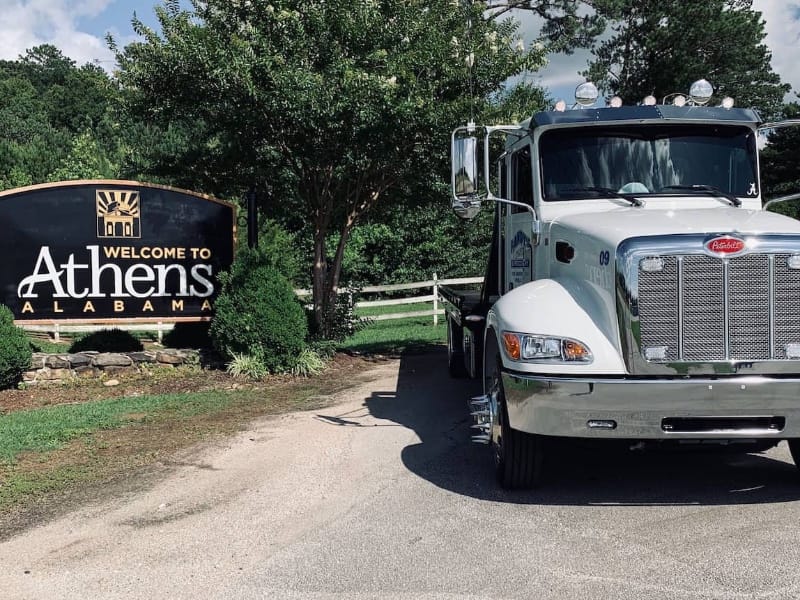
Highway recoveries call for configurations that local calls rarely require. Flatbeds handle high-damage vehicles without putting further stress on the drivetrain. Extended boom setups reach vehicles that have left the roadway or gone into a ditch. Heavy rigging covers commercial truck incidents, which are a consistent part of highway call volume across North Alabama.
Reading the Scene Before the Hook Goes Down
A car on a live highway shoulder sits in a high-exposure position that only grows more dangerous with time. Our operators treat shoulder exposure as the primary constraint on any highway call. Once the environment is controlled and the vehicle is secure, the pace normalizes.
Every part of a highway call is built around that setup happening correctly.
City and Town Work Runs on Different Rules
Street-level towing on a Tuscumbia towing call across the Shoals brings spatial challenges that highway work does not. Parked vehicles on both sides, narrow lanes, low clearances, and driveways that leave little room for a full-size tow truck all shape the approach before rigging begins. City operators develop a fast, instinctive read of these factors through work on varied streets over time.
Traffic on a city call is close-range and continuous. Vehicles approach from short distances, and there is limited room to set up without affecting traffic flow. Getting positioned correctly without creating a secondary problem is something an experienced crew does cleanly, and that clean execution comes from repetition across a range of real-world environments.
How Equipment Choices Change
Here is how the two environments typically compare:
Highway calls typically require:
- Flatbeds, rotators, and heavy wreckers for off-road and high-damage recoveries
- Extended rigging for semis, buses, and commercial loads
- High-intensity warning lighting for corridor scene control
City and town calls typically require:
- Compact wheel-lift units for residential street access
- Short-wheelbase trucks for tight driveways and narrow lanes
- Standard lighting and fast repositioning when the approach angle needs to change
Our Tuscumbia towing dispatchers ask the right questions before the truck rolls because the answers determine what unit goes out the door.
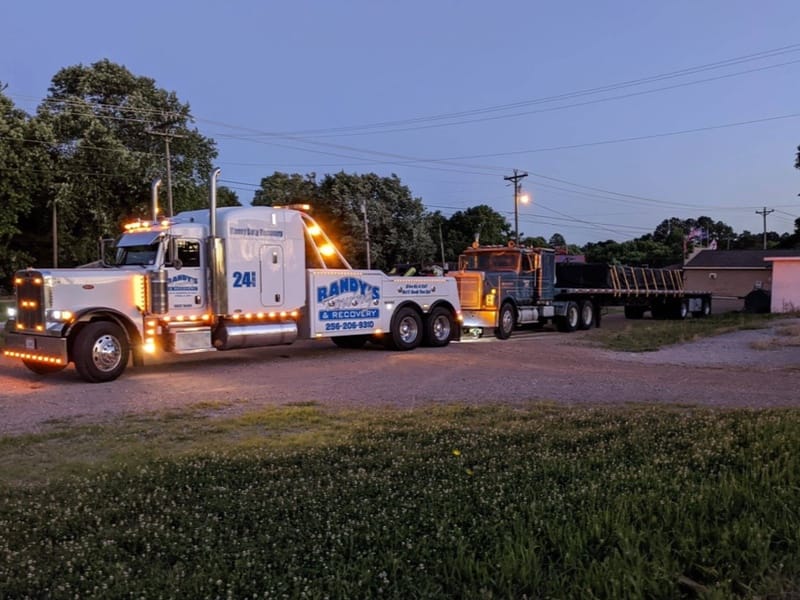
Randy’s Towing & Recovery – Cars & Heavy-Duty Semi-Truck Wrecker: Tuscumbia Towing the Shoals Has Relied On Since 2008
Randy’s Towing & Recovery – Cars & Heavy-Duty Semi-Truck Wrecker has been serving the Shoals since 2008, built from the ground up by a family with real road miles behind them. Justin grew up on these calls, learning from his dad and his granddad, and that experience shapes how our crew approaches every job today. From light-duty flatbed towing to heavy-duty recovery and rotator work, what started as a family operation has grown into a full Tuscumbia towing service covering Tuscumbia, Florence, Sheffield, Muscle Shoals, Athens, Ardmore, Huntsville, Madison, and beyond.
When a Tuscumbia towing call comes in from a highway corridor or a neighborhood street, the response is the same: the right truck, the right crew, and work done without shortcuts. Our Tuscumbia towing team is trusted by the Alabama State Police, local departments in Athens, Muscle Shoals, Florence, and Sheffield, and both the Limestone and Colbert County Sheriff’s Offices, because consistent performance on scene is how that trust gets built.
FAQ
What is the difference between a wheel-lift tow and a flatbed tow?
A wheel-lift tow uses a metal yoke that hooks under the front or rear wheels to lift and drag the vehicle. A flatbed loads the entire vehicle onto a flat platform, keeping all four wheels off the ground. Flatbeds are generally safer for all-wheel-drive vehicles, low-clearance cars, and vehicles with significant front-end or undercarriage damage.
How do towing companies decide which truck to send on a call?
Dispatchers ask about the vehicle type, the situation, and the location before assigning a unit. A standard passenger car on a flat residential street needs different equipment than a loaded commercial truck on an interstate shoulder. The goal is to match the right equipment to the job before the truck leaves the yard.
What should I do while waiting for a tow truck on a highway shoulder?
Get as far off the travel lane as possible, turn on your hazard lights, and stay inside the vehicle with your seatbelt fastened if traffic is moving nearby. If you must exit the vehicle, move to the side of the car away from traffic and stay behind the guard rail if one is present. Call dispatch with your exact location, including the nearest mile marker.
Does a towing company need to be certified to handle commercial trucks?
Heavy-duty towing requires operators with specific training, proper equipment ratings, and in many cases, knowledge of cargo securement and hazmat protocols. Not every towing company is equipped for commercial loads. When calling for a semi or large commercial vehicle, confirm upfront that the company has heavy-duty equipment and trained operators before they dispatch.
Can a tow truck damage my vehicle if it is not rigged correctly?
Yes. Improper rigging can stress the drivetrain, scratch the undercarriage, or cause the vehicle to shift during transport. All-wheel-drive vehicles are particularly sensitive because lifting the wrong axle can damage the drivetrain. A professional operator will confirm the correct lift points and secure the vehicle properly before moving it.