
When Trouble Starts Before the Curve
A semi rollover can appear sudden from the driver’s seat, but the forces behind it may have been building for several seconds. Speed, trailer height, cargo distribution, and the shape of the road all influence how much weight shifts during a turn. For drivers who may eventually need US-72 semi towing, recognizing those factors early gives them more opportunities to keep the truck planted.
Think about how differently a loaded vehicle behaves from an empty passenger car. Much of a trailer’s weight sits high above its axles, creating a higher center of gravity. When the truck turns, momentum wants to continue carrying that mass forward while the tires redirect the truck. Too much lateral force can eventually lift the inside wheels.
Cargo Can Have a Mind of Its Own
The load inside the trailer changes the equation. Poorly secured freight can slide as the truck enters a curve, moving the center of gravity at exactly the wrong moment. Tankers present another challenge because liquid can surge from side to side when the tank is only partly full.
Crosswinds can add pressure against a tall trailer, particularly when the truck is lightly loaded. Sudden steering inputs also matter. Swerving to avoid debris or another road user can create a rapid weight transfer that leaves little time for correction. The safest response starts with giving the truck enough space and speed margin before trouble develops.
Keep the Correction Out of the Curve
Drivers can reduce rollover risk by doing their braking before the turn instead of trying to lose excessive speed halfway through it. That principle applies on commercial truck routes around US-72, where ramps, intersections, changing traffic, and curves can interrupt otherwise long stretches of highway. Looking far enough ahead gives the driver more time to make gradual adjustments.
The basic habits are straightforward:
- Check load distribution and securement before leaving.
- Enter curves at a conservative speed.
- Leave additional room around surrounding traffic.
- Make lane changes gradually.
- Pay attention to wind conditions.
- Treat unusual trailer movement as a reason to slow down.
Those habits become particularly important for high loads and tankers. If a rig does leave the pavement or overturn, heavy truck recovery along US-72 can involve stabilizing and repositioning the combination before it can be transported. Semi recovery near US-72 may also depend on cargo condition and the terrain where the tractor or trailer comes to rest.
Randy’s Towing and Heavy-Duty Support
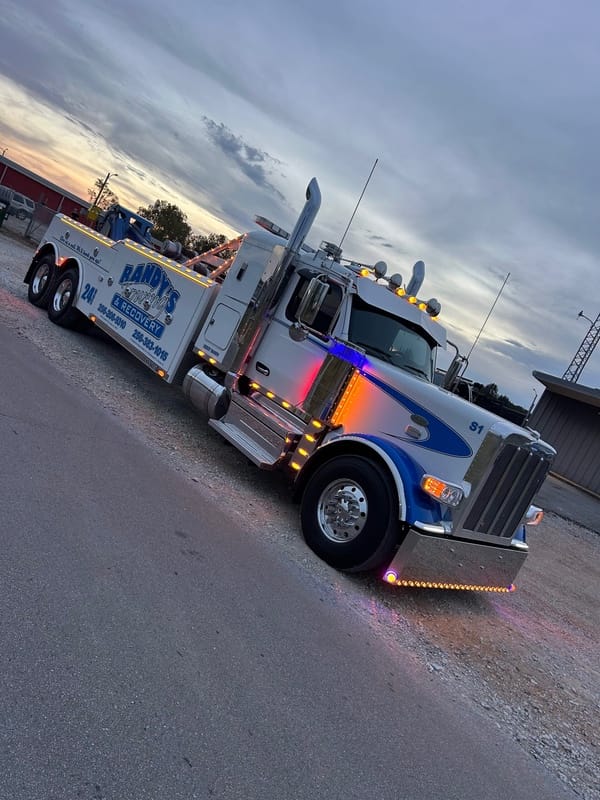
Randy’s Towing & Recovery has served the Shoals area since 2008, but the family’s experience around wreckers and big rigs started much earlier. Justin grew up riding in an 18-wheeler with his granddad and working weekend wrecker shifts with his dad. Today, our family operation handles light, medium, and heavy-duty towing, equipment transport, rotator work, and difficult recovery jobs, including US-72 heavy-duty towing for commercial vehicles.
Our team serves drivers across Muscle Shoals, Florence, Sheffield, Tuscumbia, Athens, Ardmore, Tanner, Huntsville, Madison, and surrounding areas. Local agencies that rely on Randy’s include Alabama State Police, area police departments, and the Limestone and Colbert County Sheriff’s Offices. For drivers needing truck recovery around US-72, we keep the approach fast, fair, and straightforward. Our commercial towing service near US-72 also gives fleets and individual truckers a local contact when a heavy rig cannot continue the trip.
FAQs
Can strong crosswinds cause a semi to roll over?
Yes, especially with an empty or lightly loaded trailer. Tall trailers give strong crosswinds a large surface to push against, so drivers may need to reduce speed as conditions change.
Why are sudden lane changes dangerous for tractor-trailers?
A quick steering movement transfers weight rapidly from one side of the truck to the other. The trailer may continue moving laterally even after the tractor changes direction, increasing instability.
How often should truckers check cargo securement during a trip?
Cargo should be checked as required by applicable regulations and whenever there is reason to suspect the load has shifted. Drivers should also inspect securement before beginning the trip.
Are tanker trucks more prone to rollovers?
Tankers can face additional rollover risk because liquid cargo moves inside the tank. Partially filled tanks can be particularly challenging because the liquid has more room to surge during turns, braking, and acceleration.
What should a trucker do if a load starts shifting while driving?
Avoid abrupt steering or braking and find an appropriate place to stop. The load should be inspected and secured before continuing the trip.
Can a rolled semi be towed immediately?
Usually, the truck must first be assessed and recovered from its overturned position. Cargo, leaks, terrain, and vehicle damage can all affect what needs to happen before towing begins.